
Summary
An AI audit is an evidence-based review of how a business uses, governs or plans to use artificial intelligence. It can assess opportunities, system performance, data protection, security, staff capability or AI search visibility. The process normally involves defining scope, discovering actual usage, reviewing evidence, testing controls and producing a prioritised action plan. Cost depends on scope, with published UK examples ranging from £250 for a narrow visibility review to £3,500 for a readiness audit.
Key Takeaways
- An AI audit is not one standardised service; readiness, governance, technical, data-protection and visibility audits answer different questions.
- A credible audit examines real workflows and embedded software, not only the tools management knows about.
- Published UK prices range from hundreds of pounds for narrow AI visibility reviews to several thousand pounds for broader readiness work.
- The useful output is an evidence-based action plan with owners, priorities, costs, limitations and verification methods.
- An AI audit does not guarantee compliance, savings, rankings or visibility in AI-generated answers.
What an AI Audit Actually Examines
An AI audit is an evidence-based review of an organisation’s artificial intelligence systems, practices or readiness against agreed objectives and criteria. It may investigate where AI could create value, whether existing systems are working safely, whether governance controls are effective, or whether AI search tools can discover and accurately describe the business.
The term is therefore broader than many businesses assume. An AI audit is not a financial audit, a conventional IT infrastructure audit or simply a questionnaire about which software employees use. It should connect evidence to business decisions.
A properly scoped audit identifies what was examined, which criteria were used, what evidence supports each finding and what should happen next. It may recommend adopting a tool, improving a process, strengthening permissions, changing a policy or deciding not to automate a particular task.
The result should not be an unexplained maturity score or a list of fashionable software. It should help the organisation make proportionate, accountable decisions.
The Main Types of AI Audit
Different providers use the phrase “AI audit” to describe substantially different services. Establishing the type of audit required is essential before comparing prices or proposals.
What is an AI readiness or opportunity audit?
A readiness or opportunity audit asks where AI might provide worthwhile business value and whether the organisation is prepared to implement it.
The work usually examines business objectives, repetitive processes, workflow bottlenecks, data quality, existing infrastructure, internal skills and likely implementation priorities. It should consider whether AI is actually the right solution. A conventional process improvement, better documentation or a simpler software change may sometimes solve the problem more effectively.
A strong opportunity review also establishes a baseline. That could include the time currently spent on a process, error rates, manual handoffs, staffing requirements or service delays. Without a baseline, later claims about improvement are difficult to assess.
This type of engagement is often advisory rather than independent assurance. It may lead to an implementation plan, but it does not automatically prove that an existing AI system is secure, compliant or technically reliable.
What is an AI governance and risk audit?
A governance audit examines whether responsibility, oversight and controls are appropriate and operating in practice.
It may review who owns each AI system, how risks are recorded, whether staff have suitable guidance, how suppliers are assessed and how incidents or changes are handled. It can also examine whether senior management receives meaningful information rather than assurances based solely on policy documents.
The distinction between policy and practice matters. A company may have an acceptable-use policy while employees use unapproved tools, share confidential information with consumer services or bypass approval processes. Interviews, access reviews, audit trails and operational records can reveal whether controls work as intended.
NIST’s AI Risk Management Framework provides four broad functions: Govern, Map, Measure and Manage. It is voluntary and does not by itself establish legal compliance or certification, but it can provide a useful structure for a proportionate review.
What is a technical or model audit?
A technical audit assesses whether an AI system performs adequately for its intended use and behaves acceptably under relevant conditions.
The scope might include accuracy, reliability, robustness, security, explainability, privacy, fairness, data flows, integrations and operational resilience. For a chatbot or agent, testing may also examine whether users can override instructions, extract information they should not see or trigger actions beyond their permissions.
The appropriate tests depend on the system and its consequences. A drafting assistant should not automatically receive the same assessment as a system that influences decisions about people or can make changes in business systems.
A conventional cybersecurity penetration test may examine networks, servers and infrastructure. That work can be valuable, but it does not necessarily test model behaviour, prompt manipulation, retrieval data exposure or excessive agent permissions. Businesses should check that the proposed technical audit covers the specific AI risks they face.
What is an AI data-protection audit?
A data-protection audit considers how personal information is collected, used, shared, stored and protected within an AI system.
It may examine accountability, transparency, fairness, security, data minimisation, individual rights, supplier contracts and data flows. Where processing is likely to create a high risk to individuals, the organisation should assess whether a Data Protection Impact Assessment is required under the applicable rules. An AI audit can test whether that assessment and its controls are appropriate, but it is not a substitute for legal advice.
The Information Commissioner’s Office has published AI audit and data-protection resources, although some related guidance is under review. Businesses should therefore verify current regulatory requirements rather than relying on an old checklist or assuming that an audit creates a legal safe harbour.
What is an AI search visibility audit?
An AI search visibility audit answers a different question: can AI-assisted search systems find, understand and accurately represent the business?
It may review whether relevant pages are accessible and indexed, whether important content is discoverable through internal links, whether business information is accurate and whether observed answers mention the organisation or cite its website. It can also examine competitors and the sources that appear in a defined sample of AI-generated responses.
This is a marketing and discoverability assessment, not an audit of internal AI governance. A business can have good AI search visibility and weak internal controls, or robust AI governance and little visibility in AI-generated search answers.
Why Businesses May Need an AI Audit
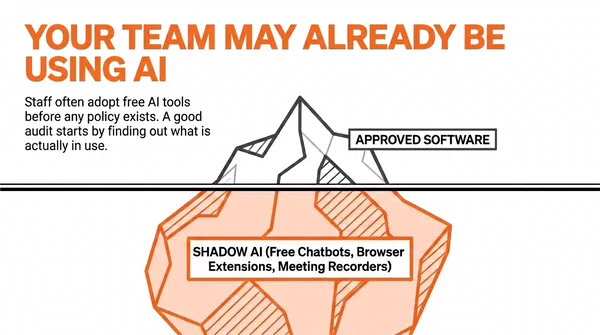
AI adoption is no longer limited to deliberate, large-scale technology projects. It can enter an organisation through free tools, software features bundled into existing products and employees experimenting with consumer services.
The UK Department for Science, Innovation and Technology’s 2026 AI Adoption Survey reported that 32% of businesses with five or more employees used at least one AI technology, compared with 16% in 2025. The same research found that limited AI skills, expertise or knowledge affected 67% of adopters and 78% of businesses planning to adopt AI.
These findings suggest that an audit should examine capability and actual usage, not just future strategy. It should look across departments and include embedded features in products such as office software, customer systems, meeting tools and marketing platforms.
The financial case also needs testing rather than assumption. Half of adopters in the survey reported an overall productivity increase, while 24% reported operating-cost reductions and 64% reported no immediate financial effect. The figures do not show that AI is ineffective; they show why the business case should be measured in the organisation’s own circumstances.
An audit can also identify where not to automate. A low-volume process with unusual exceptions may be more expensive to automate than to manage manually. A task involving sensitive decisions may require human review even if an AI tool can technically perform it. Avoiding a poor project can be a valuable audit outcome.
The AI Audit Process Businesses Should Expect
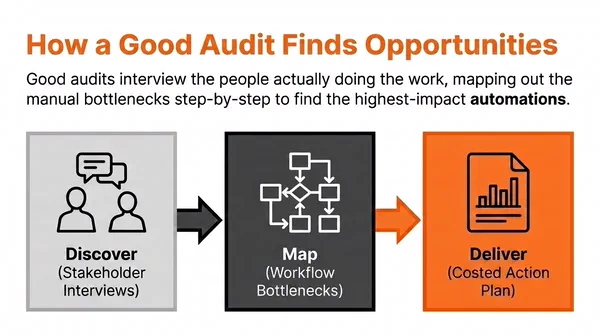
The precise sequence varies, but a credible engagement normally follows a structured path from scope to evidence, testing, reporting and follow-up.
Agree the scope and assessment criteria
The auditor should begin by defining the business decisions the audit must support. The scope should identify the departments, workflows, systems, suppliers, locations and intended uses being examined. It should also state exclusions.
The criteria might come from an internal policy, a recognised risk-management framework, data-protection requirements, contractual obligations or technical performance objectives. The proposal should explain what “good” means for the particular system rather than applying an identical checklist to every organisation.
At this stage, the business should also agree how confidential information will be accessed, stored and protected. Data handling arrangements are part of the engagement’s governance, not an administrative detail to resolve later.
Discover actual AI use
The next stage is to create an inventory of deployed, embedded and proposed AI tools. This should include systems used by employees without a formal procurement process.
A non-punitive disclosure exercise can help uncover so-called shadow AI. Staff are more likely to provide useful information if the purpose is to understand risk and improve guidance rather than punish experimentation. Reviewing software invoices, supplier records and relevant access information may identify additional tools, but interviews remain important because not every use leaves an obvious procurement trail.
The auditor should map how tools are used within real workflows. A tool that appears low-risk in isolation may receive sensitive data, influence customer communications or connect to systems with broader permissions than expected.
Review documents and interview process owners
Evidence review may cover policies, supplier contracts, data-flow diagrams, impact assessments, security documentation, test results, incident records, permissions and monitoring arrangements.
Front-line staff should be involved rather than relying only on senior management. Employees who perform the work often know about manual workarounds, repeated errors, unapproved tools and gaps between written procedures and actual behaviour.
Short, focused interviews can make this process more effective. Asking participants to record how their time is spent before an interview can help distinguish genuine bottlenecks from general perceptions and produce more useful workflow evidence.
Test systems and controls
Testing should examine both the AI output and the controls around it. Depending on scope, this may involve performance testing, accuracy checks, review of failure cases, access-control testing, supplier assessment, bias considerations, privacy review or adversarial testing.
For an AI agent, the audit should consider what it can access, what it can change, which actions require human approval and how actions are recorded. For a content or drafting tool, the emphasis may be on information leakage, factual errors, review procedures and staff understanding of limitations.
The auditor should record the test method, sample, limitations and results. A single successful demonstration does not establish reliable performance, especially where outputs vary between prompts, users or dates.
Evaluate findings and prioritise actions
Findings should be assessed according to business impact, likelihood, urgency, feasibility and the quality of supporting evidence. A critical weakness in a system handling sensitive information should not be buried alongside a minor documentation gap.
A useful finding connects the evidence to the consequence and then to a practical response. For example, if staff are entering confidential information into an unapproved tool, the recommendation might involve approved alternatives, access controls, staff guidance, supplier review and a process for reporting future use.
The audit should also identify dependencies. An automation recommendation may require better data, an integration, training, a revised approval process or additional human review before it is viable.
Report the results and agree ownership
The final report should explain the scope, criteria, systems examined, evidence reviewed, tests performed, limitations and findings. It should include an executive summary for decision-makers and enough detail for responsible teams to act.
Recommendations should have owners, priorities, dependencies and a way to verify completion. The report should make clear whether implementation, staff training, technical remediation and retesting are included in the quoted fee or require separate work.
A credible audit does not imply that every recommendation will deliver guaranteed savings or immediate returns. It gives the business a better basis for deciding what to do, what to measure and what to leave unchanged.
How Much Does an AI Audit Cost?
There is no reliable single market price for an AI audit because the term covers very different services.
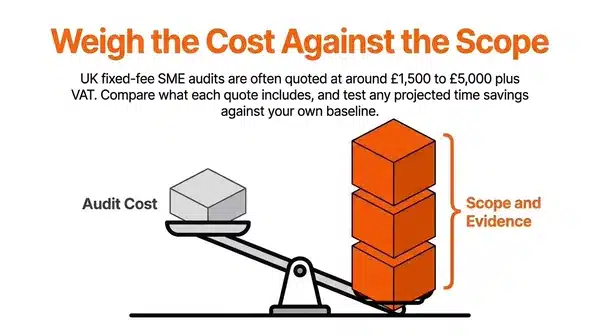
Published UK examples illustrate the range. A narrow AI visibility audit has been advertised at £250 excluding VAT, while other visibility services list prices of £595, £800, £1,995 plus VAT and £2,500 plus VAT. These services are not directly comparable because they differ in the number of questions, competitors, platforms, markets, tests, reporting detail and support provided.
A broader AI readiness audit has been advertised at £3,500 net of VAT. The provider describes a review of workflows, data, skills, governance and recommendations. Readiness providers reviewed in the research describe engagements lasting roughly one to three weeks, but that is an advertised service model rather than an industry-wide completion standard.
A small internal review may have little external cost but still consumes staff time and is unlikely to provide independent assurance. More complex work involving multiple departments, sensitive data, technical testing, supplier reviews or formal reporting will normally require a bespoke quotation.
The main cost drivers are the number of systems and workflows, the availability of documentation, the number of interviews, the consequences of errors, the depth of technical testing, the number of suppliers and integrations, and whether implementation or retesting is included.
When comparing quotations, businesses should ask what is excluded. A low headline price may cover only a written report based on questionnaires, while a higher price may include interviews, evidence testing, system analysis and a findings workshop. Neither is automatically better; the scope must match the decision the organisation needs to make.
What Should the Final Report Contain?
A useful report should provide more than general statements such as “the business should embrace AI”. It should show what was examined and how the conclusions were reached.
At minimum, the business should expect a clear scope, an inventory of systems or workflows, identified evidence, test methods and limitations, findings linked to business consequences, and a prioritised action plan. Recommendations should indicate responsible owners and explain how remediation or improvement can be verified.
For an opportunity audit, the report should distinguish promising use cases from ideas that are too costly, risky or immature. It should consider implementation effort, ongoing running costs, training, review time and error correction rather than treating all hours saved as cash.
For a governance or technical audit, the report should distinguish controls that exist on paper from controls that were tested and found to operate. It should state unresolved risks rather than presenting a false impression of completeness.
The most useful format is often: finding, supporting evidence, business consequence, recommended action, owner and verification method. That structure turns the report into a management tool rather than a document that is filed and forgotten.
How to Choose an AI Auditor
Start by selecting the type of audit required. A provider specialising in AI search visibility may not have the expertise to test data protection, model security or agent permissions. Equally, a technical security firm may not be equipped to assess workflow suitability or the commercial case for automation.
Ask which frameworks, criteria and methods will be used. Check whether the auditor will interview front-line staff, inspect evidence and test operational behaviour. Ask how sensitive information will be handled and whether findings will be independently reviewed.
Independence also deserves attention. A provider that sells implementation services can still produce useful advisory work, but the commercial relationship should be transparent. Businesses should understand whether the same organisation will recommend, build and later assess its own system.
Warning signs include an undefined scope, guaranteed savings, a report based only on a questionnaire, a proprietary score with no supporting evidence, recommendations limited to the auditor’s own tools, and no explanation of what implementation or retesting costs extra.
AI Audits Should Continue After the First Report
An audit is a point-in-time assessment, not permanent approval. AI systems, models, data sources, suppliers, permissions and intended uses can change.
The organisation should decide how findings will be tracked and when material changes trigger reassessment. A new integration, a change in the model, access to a new dataset or the introduction of an agent capable of taking actions may require a further review.
Ongoing monitoring should be proportionate to risk. A low-risk drafting assistant may need basic review and incident reporting, while a system connected to customer records or operational systems may need more formal testing, access controls and approval records.
The central value of an AI audit is not the label or score. It is the replacement of assumptions with evidence, followed by decisions that have clear owners and can be checked over time.
Research Insights
| Topic / Area | Key Finding | Business Impact | Why It Matters |
|---|---|---|---|
| AI adoption | 32% of UK businesses used AI in 2026 | More existing usage requires review | Audits should examine current tools |
| Capability gap | Skills limits affected 67% of adopters | Training may be a control priority | Software alone does not ensure safe use |
| Accuracy concerns | 56% cited bias or accuracy concerns | Testing should cover output quality | Trust requires evidence, not assumptions |
| Financial effect | 24% reported cost reductions; 64% none | Business cases need realistic baselines | Adoption does not guarantee savings |
Sources
Department for Science, Innovation and Technology – AI Adoption Survey 2026 Executive Summary
Frequently Asked Questions
Is an AI audit the same as an AI readiness assessment?
No. A readiness assessment usually focuses on opportunities, capability, data and implementation priorities. An AI audit may also examine governance, technical performance, security or data protection. Some readiness engagements are advisory and should not be described as independent assurance.
Can a small business carry out an AI audit internally?
A small business can begin with an internal inventory of tools, workflows, suppliers, data types and known risks. However, an internal review may lack independence or specialist testing capability. External support is more valuable where systems affect customers, sensitive data, employees or important business decisions.
Does an AI audit include implementation?
Not automatically. Some providers include an action plan or limited follow-up, while others sell implementation separately. The proposal should state clearly whether it covers policy changes, technical fixes, staff training, integration work, retesting and ongoing monitoring.
Does an AI audit prove legal compliance?
No. An audit can assess controls against agreed legal or regulatory criteria and identify gaps, but it does not create automatic compliance. Requirements depend on the facts, jurisdiction and use case. Significant data-protection or regulatory decisions should be checked with appropriately qualified advisers.
How often should an AI audit be repeated?
There is no universal timetable. Reassessment should follow risk and material change. A review may be appropriate after a major model, data, supplier, integration, permission or intended-use change. Higher-risk systems may also need more continuous monitoring than occasional scheduled reviews.