
Summary
An effective AI training needs assessment compares the capabilities required for specific AI-enabled tasks with the capabilities employees can demonstrate today. Start with business priorities, map tasks and risks, define observable role-based standards, and use practical evidence rather than confidence alone. Then distinguish training gaps from workflow, tool, governance and management problems, prioritise the highest-value needs, and reassess after implementation.
Key Takeaways
- Assess real tasks and decisions, not general confidence with AI tools.
- Separate knowledge, skill, performance, risk and strategic gaps before choosing training.
- Evaluate verification, data handling, judgement and escalation alongside prompting.
- Use different competency standards for employees, managers, specialists, technical teams and leaders.
- Measure changes in work quality, risk, cycle time and adoption—not just course completion.
Start with the Work, Not the AI Tool
An AI training needs assessment is a structured process for identifying the capabilities people need to use AI productively and responsibly, comparing those requirements with demonstrated capability, and deciding how to close the difference.
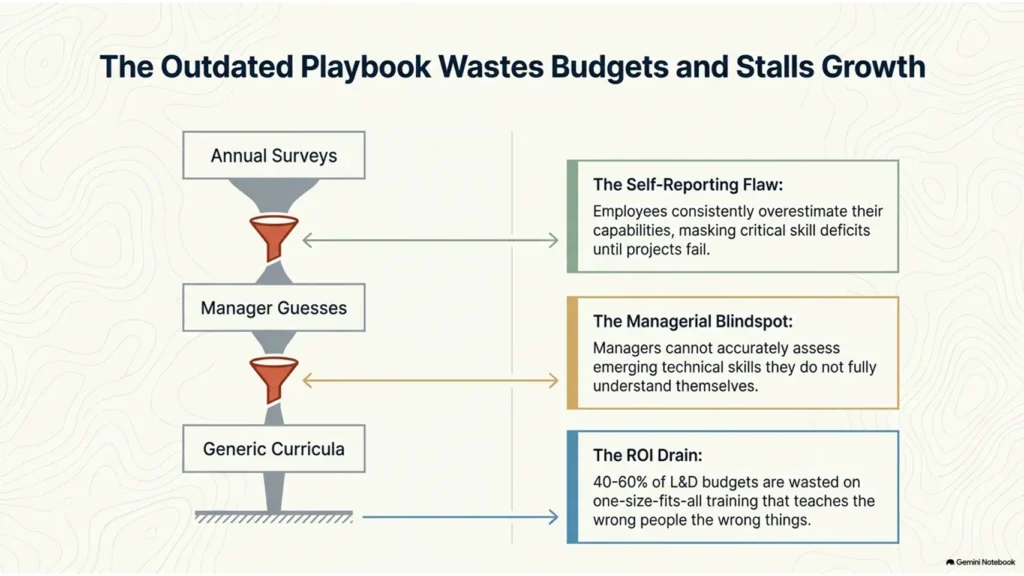
That definition matters because asking employees whether they “need AI training” produces limited insight. A stronger question is whether a person can complete a specific task safely and to the required standard.
For example, assessing whether a procurement manager can “use ChatGPT” is vague. Assessing whether they can create a first-pass supplier-risk summary without entering confidential information, verify its claims against approved sources, and document human approval is specific and measurable.
The assessment should therefore begin with business priorities. Identify the workflows where AI could improve quality, reduce avoidable effort, increase responsiveness or reduce risk. These might include proposal drafting, customer-service responses, document review, marketing production, meeting actions or demand forecasting. The objective is not to train everyone on every available tool. It is to build capability around valuable, approved uses.
The scale of the challenge makes this a strategic issue rather than a narrow learning-and-development exercise. The World Economic Forum reports that 63% of employers identify skills gaps as a major barrier to transformation, while 59% of the global workforce is expected to require training by 2030. Its research also estimates that 39% of existing skill sets may be transformed or become outdated between 2025 and 2030. These figures are global estimates, not a measurement of every UK organisation, but they support the case for continuous capability planning rather than a one-off course.
Define the Gap Before Choosing the Intervention
Not every problem revealed by an assessment is a training problem. Treating every weakness as a knowledge deficit can lead to expensive learning programmes that do not change performance.
Knowledge gaps
A knowledge gap exists when someone does not understand relevant AI concepts, tool limitations, data rules or organisational policy. An employee may not know that confidential customer information must not be entered into an unapproved system, or may not understand why AI-generated content requires checking.
Foundational learning, guided demonstrations and policy-based scenarios are appropriate responses.
Skill gaps
A skill gap exists when a person understands the principles but cannot reliably perform a relevant task. They may know that outputs need verification but fail to identify unsupported claims in a realistic document. They may understand the approved workflow but struggle to provide the right context or instructions.
Practical exercises, feedback, templates, coaching and repeated work-based practice are more suitable than general awareness content.
Performance and control gaps
A performance gap occurs when people have the necessary ability but cannot apply it because of poor tools, restricted access, inadequate data, unclear approval processes, insufficient time or weak management support. Training cannot compensate for a workflow that makes safe use impractical.
A risk or control gap is different again. It occurs when AI is being used without appropriate privacy safeguards, documentation, human review, escalation routes or quality controls. The response may involve a new policy, a secure platform, approval rules, system configuration and scenario practice, with training supporting those changes.
A strategic gap arises when AI activity is disconnected from business priorities. In that case, the organisation may need clearer ownership, use-case selection, investment decisions and leadership alignment before it needs more employee training.
Assess Five Dimensions of AI Capability
A useful framework combines business value, role exposure, capability, responsible use and adoption conditions.
AI literacy and conceptual understanding
Everyone who interacts with AI-enabled work needs a basic understanding of what the system can and cannot reliably do. This includes recognising uncertainty, understanding that fluent output is not evidence of accuracy, knowing when AI should not be used and following approved-use guidance.
The required depth will vary. An employee producing an internal draft does not need the same technical understanding as someone evaluating a model, managing sensitive data or approving an AI-supported decision.
Tool fluency and workflow design
Frequent users need more than the ability to write a simple prompt. They need to provide useful context, define the required output, refine instructions, work with approved sources and fit AI into an existing process.
The assessment should examine whether the person can produce a usable result consistently, not whether they know a collection of prompting techniques. Tool fluency is valuable only when it supports a sound workflow.
Critical evaluation and output verification
This is one of the most important and frequently overlooked dimensions. AI can produce polished text, code or analysis that contains factual errors, omissions, bias or unsupported conclusions.
A practical assessment can give employees an AI-generated output containing deliberate weaknesses and ask them to identify what should be checked. The person should be able to trace important claims to reliable sources, distinguish fact from suggestion, identify uncertainty, apply domain knowledge and decide when human escalation is required.
For a marketing team, this may mean checking claims against substantiated evidence. For customer service, it may mean validating advice against the current knowledge base. For finance, it may involve checking calculations, assumptions and approval requirements.
Responsible use and governance
Assess whether people can handle personal, confidential and commercially sensitive information appropriately. They should understand intellectual property considerations, bias risks, human oversight, documentation expectations and escalation procedures relevant to their work.
The EU AI Act provides a useful example of why this must be role-specific. Article 4 has applied since 2 February 2025 and requires providers and deployers of AI systems to take measures supporting AI literacy among staff and others operating systems on their behalf. The European Commission describes literacy in terms of factors such as technical knowledge, experience, education, training, the context of use and the people affected. It does not prescribe one universal course or certificate.
Adoption conditions
Finally, assess whether employees have the conditions needed to apply the capability. This includes access to approved tools, suitable data, time to practise, manager support, clear quality standards and integration with existing systems.
Microsoft’s Work Trend Index highlights the difference between individual capability and organisational readiness. Its survey reports that only 26% of AI users said leadership was clearly and consistently aligned on AI. That finding is from Microsoft’s survey rather than a universal measure, but it reinforces the need to assess the operating environment alongside individual skills.
Segment the Assessment by Role and Risk
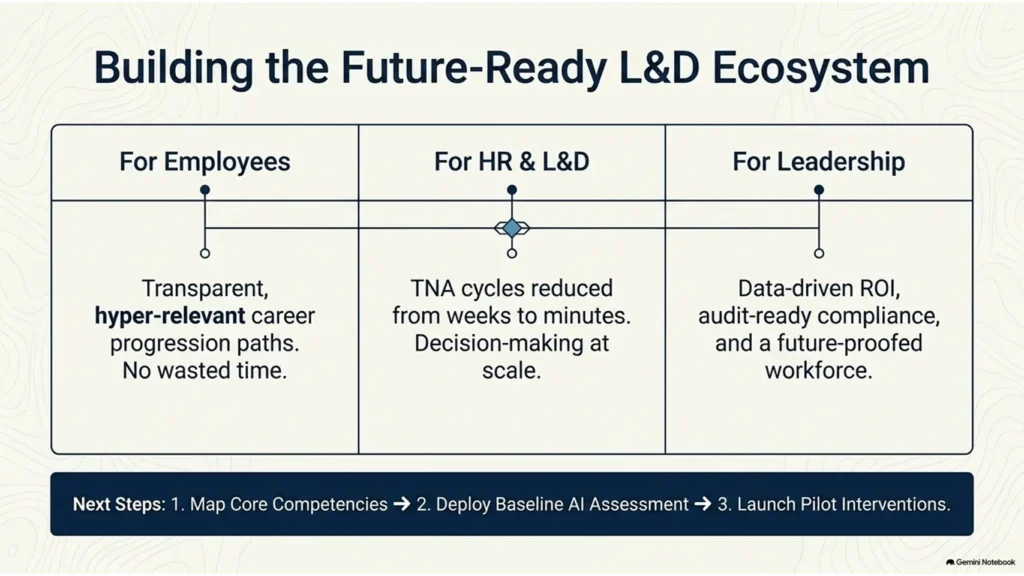
A single organisation-wide AI competency standard is too broad to guide decisions. Use a common foundation, then add requirements based on the person’s role, level of autonomy and potential impact of error.
All employees may need to understand approved tools, confidentiality, verification, limitations and escalation. Frequent users need stronger workflow design, source checking, quality assurance and documentation skills. Managers need to select suitable use cases, set boundaries, review quality, coach staff and measure outcomes.
Functional specialists require domain-specific controls. HR teams may need to examine fairness, confidentiality and consistency. Marketing teams may need to verify claims and avoid misleading content. Finance teams may need stronger controls around calculations, records and approvals. Customer-service teams need clear rules for exceptions, vulnerable customers and unauthorised commitments.
Technical and data teams require capability in data quality, security, model evaluation, monitoring, bias testing and incident response. Senior leaders and AI owners need to make decisions about strategy, investment, accountability, risk appetite and supplier diligence. Contractors and suppliers may require organisation-specific guidance on approved tools and secure data handling.
This role-based approach also prevents a common error: treating prompt writing as the definition of AI competence. A person who can generate impressive output but cannot verify it may represent a higher operational risk than someone who uses AI more cautiously.
A Seven-Stage Assessment Process
Align with strategy and select priority workflows
Begin with business leaders and process owners. Select a manageable set of high-value workflows rather than attempting to assess every possible use of AI. Record the desired outcome, current performance measure and reason AI is being considered.
Each use case should have a business owner. HR or L&D can facilitate the assessment, but responsibility for the outcome should remain with the function that owns the work.
Build an AI and workforce inventory
Record approved tools, embedded AI features, known users, business owners, data types, suppliers and affected teams. Include unapproved or informal use where it can be identified responsibly. Otherwise, the organisation may assess only official use while missing shadow AI that creates real risk.
Include people who supervise, approve, check or are affected by AI-supported work, not only those who operate the tool directly.
Map tasks and decision points
For each priority workflow, document the task, inputs, desired output, quality standard, data sensitivity, consequences of failure, human decision point and escalation route.
Task-level mapping is essential because one job may contain both low-risk drafting and high-risk decision support. A job title alone cannot show the capability required.
Set observable proficiency standards
Define what good performance looks like. Standards might state that a person can identify unsuitable confidential inputs, create a usable first draft, detect unsupported claims, use approved sources, document review or escalate a high-impact output.
A four-level scale can keep the framework manageable: awareness, guided user, independent practitioner, and expert or owner. The wording matters more than the labels. Each level should describe observable behaviour rather than confidence or attendance.
Gather several forms of evidence
Use self-assessment and employee interviews to understand confidence, experience and perceived barriers, but do not treat them as proof of competence. Combine them with short knowledge checks, realistic simulations, work-sample reviews, manager observation and appropriate usage or quality data.
Manager input remains useful when managers have a clear rubric and are calibrated against examples. It should not be the only evidence, particularly when managers are still developing their own AI capability.
Protect psychological safety throughout the process. Explain that the assessment is designed to identify support and improve work, not quietly rank people for redundancy or punishment. If employees fear the results, they may avoid participation or alter their answers, reducing the reliability of the assessment.
Prioritise the highest-value gaps
Compare the required proficiency with the demonstrated level for each role and task. Then prioritise using business impact, gap severity, risk exposure and the number of people affected. Feasibility should modify the decision: a learning intervention is unlikely to transfer if employees lack access, time, suitable data or manager support.
This prevents a low-risk, widely shared gap from automatically displacing a smaller but urgent control gap.
Link action to measurement and reassessment
For every priority gap, specify the intervention, owner, timeline and success measure. The response may be training, coaching, workflow redesign, a secure tool, a template, policy clarification or additional approval controls.
Reassess using practical evidence after people have had time to apply the learning. Useful measures include time to proficiency, error and rework rates, cycle time, adoption of approved practices, correct escalation, quality sampling and relevant customer or operational outcomes. Course completion and satisfaction can be recorded, but they do not demonstrate transfer.
A six- to twelve-month review cycle is a reasonable planning point, with earlier reassessment after a material change in tools, workflows, suppliers, regulation or incidents.

Build the Assessment into Governance
The assessment should leave an evidence trail: the AI inventory, role and task matrix, proficiency standards, assessment results, intervention decisions, attendance records, performance evidence and review dates.
For organisations developing, providing or using AI systems, ISO/IEC 42001 offers a relevant management-system reference. Its focus on defined responsibilities, risk assessment, monitoring and continual improvement supports a recurring approach to capability and governance.
The UK government’s AI Skills Framework and Employer AI Adoption Checklist are also useful starting points. They distinguish technical, non-technical and responsible or ethical skills across different levels of work, while helping employers assess readiness and plan inclusive adoption.
Automation can support the process, but it should not remove human judgement. Rule-based logic can compare required and current proficiency consistently. Generative AI can then help match an identified gap to pre-approved learning resources and draft a development plan. A human should validate the assessment result and any change to an official skills record, particularly where automated scoring could affect employment decisions.
The goal is not to make every employee an AI expert. It is to ensure that each person has the capability, judgement and support required for the AI-enabled decisions they make.
Research Insights
| Topic / Area | Key Finding | Business Impact | Why It Matters |
|---|---|---|---|
| Workforce capability | 59% may need training by 2030 | Requires ongoing workforce planning | One-off courses will not keep pace |
| Transformation barriers | 63% of employers cite skills gaps | Slows technology-led change | TNA becomes a strategic activity |
| UK capability framework | Covers technical, non-technical and responsible skills | Supports role-based assessment | Avoids generic AI training |
| EU AI literacy | Article 4 applies from 2 February 2025 | Requires context-sensitive staff capability | Training needs documented justification |
| AI management systems | ISO/IEC 42001 stresses monitoring and improvement | Supports recurring skills reviews | Connects learning with governance |
Sources
- World Economic Forum – The Future of Jobs Report 2025
- UK Government – AI Skills Tools Package
- European Commission – AI Literacy Questions and Answers
- ISO – ISO 42001 Explained
Frequently Asked Questions
How often should an AI training needs assessment be repeated?
Review the assessment every six to twelve months as a baseline, but do not wait for the scheduled review after a significant change. New tools, altered workflows, regulatory developments, supplier changes or an AI-related incident should trigger an earlier reassessment.
Should every employee receive the same AI training?
Everyone may need a common foundation in safe and responsible use, but deeper training should reflect role, task and risk. A customer-service adviser, finance approver, software engineer, manager and executive make different decisions and therefore need different proficiency standards.
Can an AI tool conduct the assessment itself?
AI can support simulations, evidence analysis and personalised learning recommendations, but it should not be treated as an unquestionable assessor. Use clear rules, protect employee data, test the assessment for bias and require human review before results affect formal records or employment decisions.
How can a business tell whether training improved performance?
Compare practical capability before and after the intervention using equivalent scenarios or work samples. Then examine workplace measures such as output quality, rework, cycle time, approved-tool adoption, correct escalation, incidents and customer outcomes rather than relying on attendance or satisfaction scores.
What should happen if the assessment finds no suitable AI use case?
Do not create training simply to demonstrate activity. Revisit the workflow, data quality, tool suitability, controls and business objective. If AI cannot improve the outcome safely or economically, the appropriate decision may be to delay, redesign or reject the use case.
If you need to discuss AI Training then please contact us