
Summary
AI Readiness products should connect proposed use cases to measurable business value, assess data, governance, people and technical controls, and show the evidence behind their findings. Look for transparent scoring with critical risk gates, deployment-specific analysis, cost modelling, prioritised remediation, named owners and ongoing reassessment. The best product supports a sound decision about what to deploy, fix, restrict or reject.
Key Takeaways
- Choose a product that assesses specific use cases, not only organisation-wide maturity.
- Require evidence-backed findings, transparent scoring and clear treatment of unknowns.
- Make data quality, security, privacy and unacceptable risks potential deployment blockers.
- Look for practical outputs such as owners, deadlines, dependencies, pilot criteria and cost estimates.
- Confirm that the product covers agent permissions, ongoing operating costs and reassessment after change.
Choose a product that improves deployment decisions
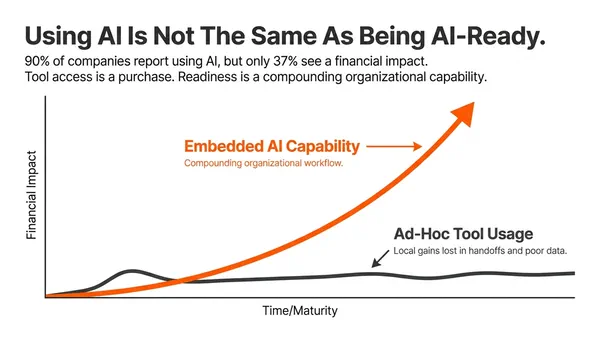
A good AI readiness assessment product should help you decide whether a particular AI initiative is worth pursuing and, if so, what must happen before it can proceed. It should not simply produce an attractive maturity score or place the organisation on a scale from “beginner” to “advanced”.
The strongest products connect business objectives with evidence about data, security, governance, skills, workflows and technology. They identify material gaps, show their consequences and turn them into an ordered plan with accountable owners. They also distinguish between a promising idea, a feasible pilot and a deployment that should be restricted or rejected.
This distinction matters because AI readiness is not one thing. A business may have strong executive support and an ambitious strategy while lacking the permissions, data quality or oversight needed for a specific application.
Does the product assess the right type of readiness?
Before comparing features, establish what the product is designed to assess. There are three related but different types of readiness.
Organisational readiness examines broad capabilities such as strategy, leadership, culture, skills, governance, data and infrastructure. Microsoft’s readiness framework, for example, covers these wider organisational foundations.
Use-case readiness focuses on a proposed application. It asks whether the problem is clearly defined, whether the expected value is measurable, whether the data is suitable, whether risks are acceptable and whether someone is accountable for the outcome.
Platform or deployment readiness examines a particular technical environment. It may consider access permissions, data exposure, security controls and configuration before an organisation deploys an assistant or connects an AI service to internal information.
These assessments complement each other rather than replacing one another. A broad organisational score cannot prove that a particular predictive model is safe to use. Equally, a technically well-configured platform does not establish that the proposed use case has a worthwhile business case.
Is it a questionnaire or a validated assessment?
Many products begin with a questionnaire. That can be useful for discovery, especially when an organisation needs to identify likely focus areas quickly. However, a short self-reported exercise should not be presented as an audit or as proof that a deployment is ready.
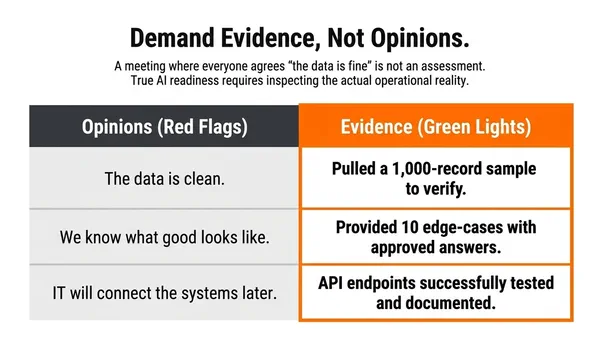
Ask what the product does with the answers. Can it attach policies, data records, test results, access reviews or other evidence to individual findings? Can different stakeholders challenge an answer? Does it distinguish verified controls from an employee’s opinion? Can it record “unknown” and “not applicable” without treating them as satisfactory responses?
The more consequential the proposed use, the more important evidence becomes. A product that only collects confident answers may measure awareness or ambition rather than operational capability.
Features that should be central to the assessment
Business objectives and use-case prioritisation
The product should begin with the business problem, not with a catalogue of technologies. It should allow you to record the proposed use case, intended users, workflow owner, current process and expected outcome.
It should also support baseline measures. These might relate to turnaround time, error rates, service quality, manual effort or cost. Without a baseline, a later claim of improvement may be difficult to interpret.
Prioritisation should consider expected value, feasibility, implementation effort, risk and the organisation’s strategic priorities. The product should be capable of concluding that an attractive idea does not justify AI, rather than assuming every proposal should advance.
A useful demonstration question is: can the product distinguish a narrowly scoped, measurable pilot from a broad idea with no accountable owner, reliable data or credible return?
The commercial case deserves particular attention. The 2026 UK government adoption survey found that 65% of non-adopters cited the absence of a clear business case or proven return on investment. This suggests that a readiness product should assess economics before technical enthusiasm turns into expenditure.
Evidence-backed and explainable scoring
A score is useful only when its meaning can be understood and challenged. Look for published assessment dimensions, clear maturity definitions and an explanation of how answers are weighted and combined.
The product should show the evidence supporting each finding, rather than placing all documentation in a separate report. It should distinguish self-reported information from verified controls, reviewer observations and unresolved assumptions. Comments, approvals, version history and an audit trail are valuable when several departments contribute to the assessment.
Treat the scoring model as a decision aid, not an industry truth. Proposed weighting schemes can help compare vendors, but there is no universal scoring standard that makes one readiness percentage objectively correct.
Pay particular attention to the treatment of critical weaknesses. A product should be able to identify a serious data exposure or missing approval process as a deployment blocker, even when other categories score highly. An average score that allows strong leadership support to compensate mathematically for unacceptable security risk is potentially misleading.
The product should also support separate views for different departments, applications or deployment stages. Enterprise-wide averages can conceal the fact that one business unit has a very different data environment and risk profile from another.
Data readiness related to the intended application
The assessment should ask whether the data required for the proposed application is usable, lawful, accessible and governed. Having a large volume of data is not the same as having suitable data.
Relevant checks include ownership, provenance, permitted use, accuracy, completeness, freshness and representativeness. The product should also examine access permissions, sensitive information, integration requirements and how data quality will be monitored after launch.
The checks need to reflect the application. An assistant searching internal documents will require different evidence from a predictive model trained on historical customer records. An agent that can change records or trigger transactions requires more stringent controls than a system that provides information for a human to review.
Prefer a product that lets you define application-specific evidence requirements rather than applying one generic data questionnaire to every initiative.
Governance, privacy and security controls
A responsible AI policy checkbox is not enough. The assessment should identify who owns the system, who can approve it, who monitors it and what happens when it produces a harmful or unreliable result.
Look for coverage of AI inventories, approved-use policies, data protection, retention, third-party data use, identity management, access permissions, supplier dependencies and contractual protections. It should also consider transparency, explainability, bias, incident response, escalation and redress where those issues are relevant.
Human oversight should be proportionate to the consequences of failure. A system supporting low-risk internal drafting may need different controls from one influencing employment, lending, healthcare or customer eligibility decisions.
Framework mapping can improve consistency. Mapping to the NIST AI Risk Management Framework or relevant management-system standards may help teams organise their work. However, alignment with a framework is not the same as compliance, certification or independent assurance. The product should make that distinction clear.
People, skills and workflow change
AI readiness is not an IT-only question. The assessment should identify the skills required by specific roles, including the ability to review AI outputs, recognise errors and escalate problems.
It should examine leadership sponsorship, training, employee concerns, workflow changes and adoption barriers. It should also identify who is responsible for implementing those changes. An assessment that recommends training without identifying the affected roles or expected behaviour is unlikely to produce much practical value.
The 2026 UK survey reported limited AI skills, expertise or knowledge as a barrier for 67% of adopters and 78% of businesses planning to adopt AI. That supports a product design that assesses capability at role level rather than asking whether the organisation is generally “AI literate”.
The workflow itself should be assessed. A tool may reduce the time spent on one task while leaving approvals, duplicate data entry or downstream reviews unchanged. A product should help reveal where a local productivity gain will, or will not, translate into a wider business benefit.
Technical integration and operational readiness
The assessment should establish whether the proposed application can operate within the organisation’s real environment. Relevant factors include system integrations, model selection, identity and access controls, performance expectations, resilience, monitoring, support ownership and model management.
Ask the supplier to demonstrate how the assessment changes for a packaged AI application, an assistant connected to internal documents, a predictive model and an autonomous agent. These deployments have different data exposures, failure modes, permissions and consequences.
The product should also consider recurring operational requirements. These may include model or API costs, token consumption, data retrieval, monitoring, evaluation, maintenance, integration changes and regression testing. A pilot that appears affordable can become unsuitable when these running costs are included.
The assessment should separate time saved from money saved. In the UK survey, half of adopters reported increased overall productivity, but 64% reported no immediate effect on operating costs. A credible product should therefore help define how benefits will be realised financially, rather than treating every efficiency improvement as a cost reduction.
Look for outputs that support action after the assessment
Does it produce a prioritised remediation plan?
A report describing weaknesses is only the starting point. The product should convert findings into a remediation backlog with a clear priority, named owner, target date, completion criterion and dependency where applicable.
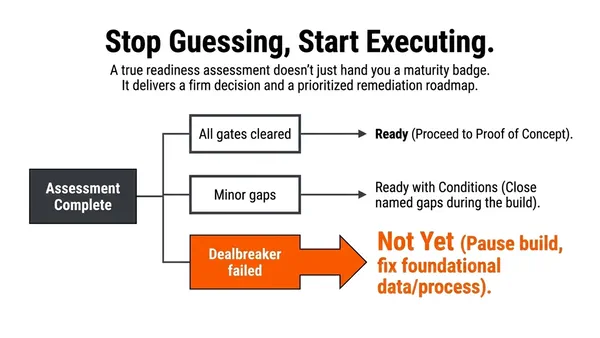
It should show what must be completed before a pilot, what can happen during the pilot and what controls are required before broader deployment. Useful decision outcomes may include proceed, proceed with restrictions, defer or reject.
Current-to-target comparisons are especially useful. They show the difference between the organisation’s present capability and the level required for a defined use case. The result should be an implementation plan that operational teams can use without needing a consultant to interpret every recommendation.
Does it model the full cost and expected value?
The business case should include more than licences or initial development. Ask whether the product can capture integration effort, usage-based charges, infrastructure, support, monitoring, human review, data maintenance and periodic reassessment.
It should allow expected benefits to be linked to a baseline and to a measurement owner. This helps distinguish a useful result, such as faster drafting, from a realised business outcome, such as reduced handling cost or increased capacity.
Where relevant, the assessment should support build-versus-buy analysis. An internal build is not automatically cheaper or easier to govern, particularly if it creates long-term maintenance and security responsibilities.
Can the assessment be repeated as conditions change?
Readiness is not permanent. Models, suppliers, permissions, data sources, regulations, users and workflows can all change the risk profile.
Look for versioned assessments, change histories, reminders and reassessment triggers. A new model provider, a new data connection, a change in user population or a move from internal assistance to customer-facing automation should prompt a review.
The process should be proportionate. A small business may need a repeatable review workflow rather than a costly continuous-monitoring platform. The important feature is the ability to revisit the decision when the conditions behind it change.
Does it cover agentic AI and delegated authority?
Generative AI and agents require additional assessment because the system may do more than produce text or predictions. It may call tools, access records, send messages or initiate transactions.
The product should examine the agent’s permissions, privileged access, approval requirements, logging, human escalation, recovery arrangements and ability to reverse an action. It should also address prompt-injection risks, sensitive data leakage and what happens when an agent encounters an unfamiliar situation.
A sensible progression is to distinguish systems that answer questions from systems that route work, provide procedural instructions, check data and take action. The further an application moves towards autonomous execution, the stronger the evidence and control requirements should become.
Test the product before you buy it
A hypothetical worked example
Suppose a customer service team wants an internal assistant that searches approved policies and suggests responses to common enquiries. The business objective is to reduce response preparation time while keeping a trained employee responsible for the final message.
An effective assessment would first record the existing preparation time, the target user group and the quality checks currently performed. It would then identify the documents the assistant must use, their owners, retention rules, update frequency and access permissions.
The product might reveal that the policy library contains duplicate documents, several files have no named owner and some shared folders include information that the proposed users should not see. It might also find that there is no agreed test set of historical enquiries against which answer quality can be assessed.
The overall organisational score could still be positive because leadership is supportive, the team has relevant skills and the business case is plausible. However, the use-case decision should be “proceed with conditions” rather than “ready”. The conditions might require document ownership, access clean-up, a representative evaluation set, human review guidance and a defined incident route.
The resulting plan should identify who will complete each action, what evidence will demonstrate completion and which issues block the pilot. This is more useful than a single maturity label because it connects the proposed application to specific work.
What should a supplier demonstrate?
Ask the supplier to show the complete path from an assessment question to a decision. The demonstration should include the answer, supporting evidence, rationale, identified gap, recommended action, accountable owner and completion test.
Use a realistic example rather than a polished sample dataset. Ask what happens when a stakeholder does not know the answer, when evidence conflicts or when a control applies to one department but not another.
For internal comparison, an illustrative buyer scorecard could give the greatest weight to assessment validity and evidence, followed by business relevance, risk and governance, remediation and follow-through, and practical usability. The exact percentages should reflect your circumstances; they are not an official benchmark. Apply non-negotiable gates first so that an unacceptable data-handling arrangement cannot be outweighed by convenience or presentation quality.
How does the supplier protect assessment information?
The assessment itself may contain sensitive commercial, personal or technical information. Ask how the provider handles retention, deletion, access control, subprocessors, model-training use, incident response and data portability.
You should also understand whether uploaded information is used to improve the supplier’s own models, whether it remains in a particular jurisdiction and how long it is retained. A product cannot credibly assess AI risk while giving vague answers about its own data practices.
Common mistakes and warning signs
Be cautious of products that treat employee adoption of an AI assistant as proof of organisational readiness. Individual experimentation can exist alongside weak governance, fragmented data and no route from pilot to production.
A generic maturity badge is another warning sign, particularly if the supplier cannot explain the evidence or the actions behind the score. Avoid tools that use one questionnaire for every application, because risk changes with data sensitivity, user access, autonomy, reversibility and potential harm.
Do not defer privacy, legal and security review until after the pilot. Nor should you budget only for the initial build while ignoring consumption, maintenance, monitoring, evaluation and workflow changes.
Finally, do not treat framework alignment as a compliance result or readiness as permission to deploy. The useful product is the one that helps you decide what to fix first, what evidence is still missing and what conditions must be met before proceeding.
Decision usefulness matters more than scoring sophistication
The best AI readiness assessment product combines organisational understanding with use-case-level validation. It examines business value, data, governance, people, technology, cost and operational change, then turns the findings into an accountable plan.
Choose the product that makes uncertainty visible, blocks unacceptable risks and supports reassessment over time. A simpler tool that improves investment and deployment decisions is more valuable than a sophisticated scoring engine that produces a report nobody can act on.
Research Insights
| Topic / Area | Key Finding | Business Impact | Why It Matters |
|---|---|---|---|
| UK AI adoption | 32% used AI in 2026, versus 16% in 2025 | Assess existing usage and controls | Adoption does not prove readiness |
| Skills barriers | Limited skills affected 67% of adopters | Identify role-specific training needs | Capability gaps can delay deployment |
| Business case | 65% of non-adopters lacked clear value or ROI | Require baseline and benefit modelling | Strategy alone cannot justify investment |
| Reliability concerns | Bias or inaccuracy concerned 56% of adopters | Require evaluation and oversight | Risk controls need practical evidence |
Sources
UK Government – AI Adoption Survey 2026: Executive Summary
UK Government – Artificial Intelligence Adoption Research Report 2026
Frequently Asked Questions
How much evidence should an AI readiness assessment require?
The evidence should match the use case and its risks. It may include policies, access records, data samples, system documentation, baseline measures, test results and stakeholder approval. A low-risk discovery exercise can begin with self-reporting, but consequential deployments require stronger verification.
Can one product assess organisational and use-case readiness?
It can, provided it keeps the two views distinct. Organisational questions assess broad capability, while use-case questions examine a particular application’s data, value, controls and owners. Combining them into one unexplained score can hide weaknesses that matter to a specific deployment.
What should a smaller business prioritise?
Prioritise clear use-case definition, data handling, security, ownership, cost and a practical remediation workflow. A smaller business may not need extensive continuous monitoring, but it should still know what information is being used, who approves deployment and how problems will be handled.
When should an organisation repeat an assessment?
Repeat it when the model, data, permissions, supplier, user group or intended purpose changes. A review is also appropriate before moving from pilot to production or from internal use to customer-facing or autonomous operation. The frequency should reflect the deployment’s risk and complexity.
Does mapping to an AI framework prove compliance?
No. Framework mapping can organise questions and reveal gaps, but it does not prove compliance, certification or assurance. Legal and regulatory obligations depend on the application, jurisdiction, sector and operating context, so specialist review may still be required.