
Summary
AI adoption is best managed as a staged programme combining workforce training, workflow redesign, governance and measurement. Start by assessing readiness, setting ownership and establishing safe-use rules. Build shared AI literacy, then move into role-based pilots before integrating successful applications into routine work. Small organisations can use lighter controls and short cycles; larger organisations need coordinated governance, specialist training and scalable technical foundations.
Key Takeaways
- AI training should develop practical judgement, verification skills and role-specific capability, not just prompting proficiency.
- Every phase needs an accountable owner, a practical deliverable and a decision about whether to proceed, revise or stop.
- Small organisations can keep governance proportionate, but sensitive data and high-impact decisions still require appropriate controls.
- A successful demonstration is not proof of business value; measure the complete workflow, including checking, correction and support.
- Advanced automation should follow proven capability and reliable oversight rather than being treated as the inevitable destination.
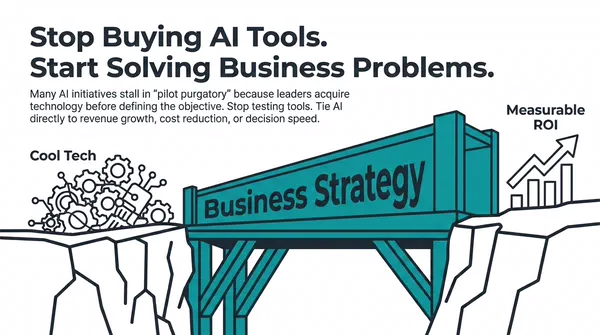
Start with readiness, not software licences
An AI adoption roadmap is a structured plan for developing the people, processes, controls and technical capability needed to use AI responsibly. It is not simply a purchasing plan, a chatbot rollout or a prompt-writing course.
Training also has a wider meaning in this context. It includes developing employees’ understanding and judgement, teaching people how approved tools apply to their roles, changing workflows and preparing technical teams to configure, test and monitor AI systems. The organisation must learn alongside its employees.
Four connected activities need to progress together. AI literacy gives people a shared understanding of capabilities, limitations, risks and responsibilities. Role-specific training shows employees how to apply approved tools to actual work. Organisational adoption changes processes, ownership, support and incentives. Technical enablement makes systems more reliable, controlled and maintainable.
The distinction matters because a person can produce an impressive response from a generative AI tool without knowing whether it is accurate, suitable for the task or safe to share. Conversely, an organisation can provide an approved platform without changing the process in which that platform is supposed to create value.
UK adoption is increasing, but workforce capability is not keeping pace. The Department for Science, Innovation and Technology’s 2026 adoption research reported that 32% of UK businesses were using at least one AI technology, compared with 16% in its previous wave. The same research found that limited skills, expertise or knowledge affected 67% of adopters and 78% of businesses planning to adopt AI.
That makes training a business-readiness issue rather than an optional benefit attached to a new tool.
Phase one: assess readiness and establish ownership
The first phase is about understanding the organisation before selecting courses, buying additional licences or promising benefits.
Begin by identifying the tools already in use, including unofficial or “shadow AI” applications. Employees may already be entering business information into public systems or using AI to draft, analyse or summarise work without consistent guidance. The aim is not to punish experimentation, but to understand the starting point and replace unsafe uncertainty with workable alternatives.
Assess digital confidence, existing AI knowledge and the needs of different roles. At the same time, map candidate workflows and establish their current performance. A useful baseline may include task time, error rates, rework, turnaround time, quality checks and customer effects.
Readiness also requires an early review of data sensitivity, customer impact, regulatory obligations and sector constraints. A small company handling employment, health, financial or learner information may face more serious risks than a larger organisation working with low-sensitivity material.
Leadership should appoint both a business sponsor and an operational owner. The sponsor removes organisational barriers and makes decisions about priorities. The operational owner understands the workflow, defines acceptable quality and remains accountable after the pilot team moves on.
What should be delivered before a pilot?
The first phase should produce a practical readiness assessment, a tool inventory, a skills map, initial approved-use rules and a prioritised shortlist of possible use cases. It should also establish an escalation route for uncertain or potentially harmful uses.
No pilot should proceed until someone owns it, the intended users are known, data boundaries are agreed and success criteria can be measured. If those conditions are absent, more training or technology will not resolve the underlying problem.
Phase two: build foundational AI literacy
Foundational training creates a common minimum standard for everyone who uses AI, including senior leaders and managers. It should explain what AI systems can do, where they are unreliable and why plausible-sounding output still requires verification.
Employees need to understand confidentiality, privacy, approved platforms, inappropriate inputs, bias, security and the importance of human responsibility. They should learn how to specify a task clearly, but prompting should be treated as one practical technique rather than the definition of AI literacy.
Verification deserves particular attention. Staff should practise checking claims, calculations, sources, missing context and unsupported certainty. They should know when to ask a subject specialist to review an output and when not to use AI at all.
A practical assessment is more useful than a completion certificate alone. Participants could be asked to identify fabricated information, spot an unsafe data-sharing decision or explain why a particular task requires specialist review. This tests whether people can apply judgement, not merely recall terminology.
The National Institute of Standards and Technology’s Generative AI Profile identifies risks including confabulation, privacy problems, harmful bias and security weaknesses. Those risks are why a short course focused only on producing better prompts is insufficient.
Phase three: deliver role-based training and controlled pilots
Once people understand the foundations, training should move into real work. Different roles need different examples, risk boundaries and quality standards.
Marketing and sales teams may practise researching and drafting material while checking claims, brand accuracy and confidential information. Customer service teams may review AI-assisted answers against approved knowledge and practise escalation. Finance and operations staff may focus on data validation, exception handling and unsupported conclusions.
HR and recruitment teams require particular care around sensitive information, bias and decision boundaries. Managers need to learn how to allocate work, assess quality, redesign processes and measure benefits. Technical teams require deeper training in access controls, integration, testing, evaluation and monitoring.
The pilot itself should have a short charter. It should define the problem, the baseline, the users, approved data, expected benefit, acceptable quality, relevant risks, review arrangements and the full implementation cost. It should also state what would cause the organisation to stop, revise or scale the work.
Training should use representative tasks rather than polished vendor demonstrations. Employees need repeated opportunities to apply the capability, receive feedback and understand how exceptions are handled. Enthusiastic volunteers can help begin a pilot, but they should not be the only people involved if the eventual workflow will be used by a wider or less confident group.
Phase four: redesign workflows and validate value
A pilot becomes meaningful only when the whole process is examined. A drafting tool may produce text quickly but create additional review, correction and approval work. The relevant question is whether the completed workflow is faster, better, safer or more valuable.
Map the process before and after AI is introduced. Include handovers, checking, correction, exceptions, customer communication and the time required to maintain prompts, templates or knowledge sources. Define who accepts responsibility for the output and who can stop the process.
Testing should include routine cases and difficult cases. Clean demonstration data can hide problems that emerge when information is incomplete, inconsistent or unusually formatted. The organisation should also assess customer and employee effects, including whether released capacity is redeployed, used to increase output or simply absorbed by additional review.
A useful planning calculation is:
Net time benefit = baseline task time − (AI-assisted work + review + correction)
This is not a guarantee of financial savings. A reduction in task time becomes a business benefit only if it creates additional capacity, increases useful output or avoids a genuine cost. Evaluation should include licences, integration, training, support and ongoing assurance.
Progression to the next phase should depend on evidence that the process works under realistic conditions, not on the enthusiasm generated by a successful demonstration.
Phase five: scale applications that have earned trust
Scaling means more than giving additional employees access to the same tool. It requires standardising the successful workflow, updating training materials, clarifying ownership and providing support.
Additional teams should learn through realistic examples from their own work. Internal champions can demonstrate approved practice and collect recurring questions, while a central support route can identify problems that require policy, technical or process changes.
At this point, technical controls may need to become more formal. Access permissions, approved knowledge sources, evaluations, monitoring and audit records should reflect the consequences of failure. Ownership should cover not only the system, but also templates, data sources, performance reviews and user guidance.
An application is ready to scale when a named owner accepts responsibility for its performance, support and risk. If quality is acceptable only when a small expert group intervenes constantly, the process may need further redesign rather than wider deployment.
Phase six: maintain capability and introduce advanced uses selectively
AI adoption is not complete when a system goes live. Models, interfaces, policies, data and business processes change. Training should be refreshed after material changes, and performance should be reassessed after a model or workflow is updated.
The organisation should review incidents and near misses, retire applications that no longer deliver value and maintain manual fallback arrangements. Decommissioning also needs planning: obsolete systems, stored data, access permissions and associated documentation should be securely closed down.
More advanced automation, including systems that can take actions, requires additional training in permissions, approval points, monitoring, escalation and recovery. Autonomous agents should not be treated as the compulsory final stage of every roadmap. The appropriate destination is sustainable, controlled use that serves a real business need.
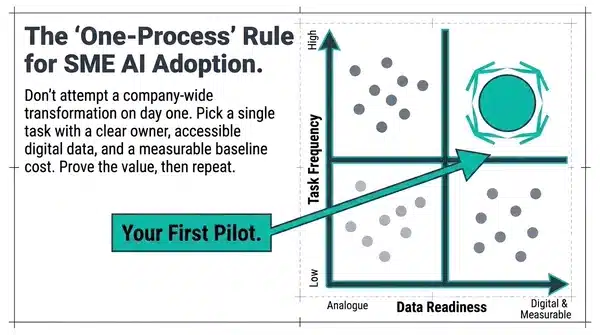
Adapt the roadmap to organisational size
Organisation size affects coordination, resources and technical complexity, but it does not determine risk by itself. Headcount bands are useful planning categories rather than universal definitions.
How should a small organisation begin?
A small organisation can usually start with one clearly defined workflow, a senior sponsor and a named implementation lead. Short workshops, guided practice, job aids and external support may be more practical than a large internal training function.
Governance can be concise. A one-page policy may specify approved tools, prohibited data, human verification requirements and the person responsible for uncertain cases. That lighter administration should not mean weaker protection where the workflow involves sensitive information or consequential decisions.
A small business should assess existing software before commissioning custom development. Its advantage is often speed and proximity to the workflow, but limited resources make it especially important to establish a baseline and avoid spreading effort across too many experiments.
What changes in a medium-sized organisation?
A medium-sized organisation often needs an executive sponsor supported by a cross-functional working group. Departmental champions can help deliver role-based learning, while common policies and measurement definitions make results more comparable.
Several pilots may run at the same time, but they should share a consistent approval process, data review and reporting approach. This is the point at which informal experimentation can become difficult to coordinate unless ownership, procurement and support responsibilities are clear.
What does a large organisation need?
A large organisation may need central standards, business-unit accountability, formal security and legal review, reusable technical controls and specialist learning pathways. An AI centre of excellence or equivalent coordinating function can reduce duplication, but it should not remove responsibility from the departments that own the work.
Enterprise training commonly combines a shared foundation curriculum with specialist pathways for managers, technical teams, risk professionals and frontline users. Portfolio-level measurement becomes important because isolated productivity improvements may not translate into enterprise value.
The scale of governance should match the application and its consequences. A large organisation should not impose unnecessary administration on low-risk experiments, while a small organisation should not assume that its size makes a high-impact application safe.
Build learning around people, work and oversight
Managers deserve dedicated training because they decide which tasks are suitable, what acceptable quality means and how capacity released by AI will be used. Without that capability, employees may become faster at individual activities without improving the team’s overall performance.
Human oversight also needs to be taught as a real capability. A person clicking “approve” is not meaningful control if they lack the expertise, time or authority to challenge the output. Reviewers need defined checks, escalation rights and clear responsibility for stopping unsuitable work.
Organisations should also consider how AI affects junior roles. If routine drafting, coding or analysis is automated, early-career employees may lose opportunities to develop foundational judgement. Training plans should preserve structured opportunities to learn domain fundamentals, validate outputs and understand the work behind the automated task.
A practical sequence is illustrated by two published WPMS AI Consulting case studies involving education organisations. Initial awareness workshops covered AI fundamentals, practical use, workflow efficiency, responsible use and GDPR considerations for tutors, managers, leadership and administrative staff. Follow-up consultations then addressed policy, data handling, safeguards and organisational consistency. The sequence demonstrates why training can reveal governance needs, rather than governance being treated as a final approval step. The reported outcomes were qualitative, including improved confidence and awareness; no financial result should be inferred.
For UK organisations with relevant European operations, the European Commission’s AI literacy guidance emphasises tailoring measures to staff knowledge, the systems used and the deployment context. It does not prescribe one universal certificate or literacy level. The EU AI Act should not be treated as a blanket UK requirement; its relevance depends on the organisation’s activities and scope.
Measure capability, behaviour and business value
Attendance proves that people encountered training. It does not prove that they can use AI safely or effectively.
A stronger measurement approach considers four levels. Participation covers attendance and completion. Capability tests practical task performance and error recognition. Behaviour examines appropriate repeat use, verification, policy adherence and escalation. Business outcomes consider quality-adjusted time, throughput, service quality, cost or revenue.
Useful operational measures include time per completed task, first-pass acceptance, error and rework rates, customer complaints, cost per transaction, appropriate escalation, incidents and near misses. Measurements should compare the complete process with the baseline rather than counting prompts, log-ins or gross minutes saved.
The distinction is supported by McKinsey’s 2026 global survey, which reported individual productivity improvements among 80% of respondents but positive enterprise-level EBIT impact among 37%. The findings are survey-based and do not show that training alone caused better performance. They do, however, reinforce the need to connect personal efficiency with workflow redesign and organisational measurement.
Review the evidence at each progression gate. The decision may be to scale, revise, pause or retire the application. Treating a stop decision as a failure can encourage organisations to continue funding tools that are not suitable.
Avoid the adoption traps that weaken training programmes
Buying licences before identifying a business problem creates access without usefulness. Begin with a workflow, its baseline and its constraints.
Giving every employee the same course ignores role differences and can leave high-risk users underprepared. Shared literacy should be combined with targeted practice.
Prompting without verification can produce fluent but unreliable work. Training should assess checking, source inspection, escalation and the ability to recognise when AI should not be used.
Attendance and usage statistics are weak measures on their own. Practical assessments and operational results provide stronger evidence of capability and value.
Scaling after a polished demonstration is another common error. Representative data, difficult cases, production latency, permissions and exception handling need to be tested before expansion.
Finally, restrictions without usable approved alternatives may encourage unofficial tools. Safe adoption depends on clear boundaries, realistic examples, accessible support and leaders who model responsible behaviour. The roadmap should remain active after launch, with periodic reviews of skills, controls, workflow results and system end-of-life.
Use progression gates rather than a fixed timetable
The roadmap can be applied in short cycles by a small organisation or coordinated across several business units by a large one. It should not be tied to an assumed 90-day transformation or a universal number of training hours.
The organisation is ready to move from readiness into literacy when ownership, priorities, data boundaries and baseline measures are clear. It is ready for pilots when users understand the foundations and the pilot has a defined problem, risk boundary and success measure. It is ready to scale when the complete workflow performs acceptably with representative users and the operational owner can support it.
The final test is whether AI has become a controlled improvement to the way work is done. If it has only created more experimentation, review burden or uncertainty, the correct next step may be redesign or discontinuation rather than further rollout.
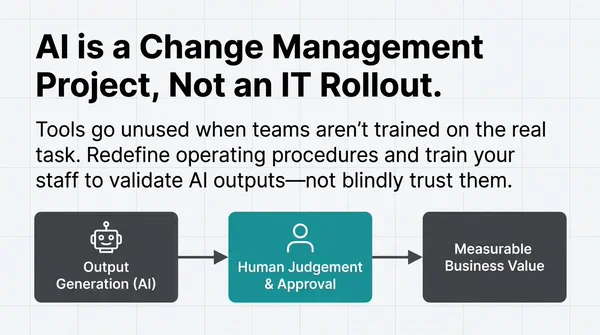
Research Insights
| Topic / Area | Key Finding | Business Impact | Why It Matters |
|---|---|---|---|
| UK AI adoption | Usage rose from 16% to 32% | More organisations need structured capability | Adoption is not yet universal |
| Skills barriers | Limited skills affected 67% of adopters | Training directly addresses a leading obstacle | Capability constrains safe use |
| Workforce training | Only 11% trained most employees | Tool access does not equal readiness | Organisation-wide skills remain limited |
| Productivity and value | 80% reported productivity gains; 37% positive EBIT impact | Workflow redesign and measurement are essential | Personal gains may not reach the organisation |
Sources
Department for Science, Innovation and Technology – AI Adoption Survey 2026
Office for National Statistics – Artificial intelligence in UK businesses, 2023 to 2026
McKinsey – AI is changing work. Now it has to change the organisation
Frequently Asked Questions
Does every employee need the same AI training?
Every employee who uses AI needs a shared foundation covering approved tools, limitations, privacy, verification and escalation. The practical training should then vary by role. A recruiter, customer adviser, manager and developer face different tasks, data risks and quality requirements.
How often should AI training be refreshed?
Refresh training after a material change to the system, policy, workflow or risk profile. Organisations should also review incidents, near misses and recurring user questions. A short periodic practice session may be more useful than repeating a generic introductory course.
Is an AI certificate necessary?
A certificate is not a substitute for practical capability. Organisations should assess whether people can recognise unreliable output, protect data, follow approved processes and escalate appropriately. Some regulated roles may have additional requirements, but the training standard should reflect the actual system and work involved.
What should an organisation do if a pilot shows no measurable value?
Review the baseline, complete workflow and quality requirements before continuing. The pilot may need a different design, better data, more training or a narrower objective. If the full process still does not justify its cost or risk, stopping is a responsible adoption decision.
How can AI adoption protect junior employees’ development?
Organisations should avoid removing every routine learning opportunity. Junior staff can be trained in domain fundamentals, output validation, exception handling and critical judgement while using AI as an assistant. Structured apprenticeships and supervised work help preserve the experience needed for future specialist and management roles.