
Summary
An AI risk audit in 2026 must examine the complete workflow, not just the model or policy. The most easily missed gaps involve incomplete inventories, incorrect legal classification, weak data lineage, excessive agent permissions, nominal human oversight, shallow testing, unmanaged supplier changes and inadequate incident records. A defensible audit shows what the system used, what it could do, who could intervene and whether controls worked in production.
Key Takeaways
- Audit the workflow and authorised actions, not only the quality of generated text.
- Reconcile AI inventories with embedded software features, employee tools and connected systems.
- Treat human oversight as a testable intervention with information, authority and time to act.
- Reassess systems after changes to models, data sources, permissions, users or purposes.
- Require evidence that production controls operated, rather than relying on policies or vendor assurances.
Why a 2026 AI risk audit must examine the workflow
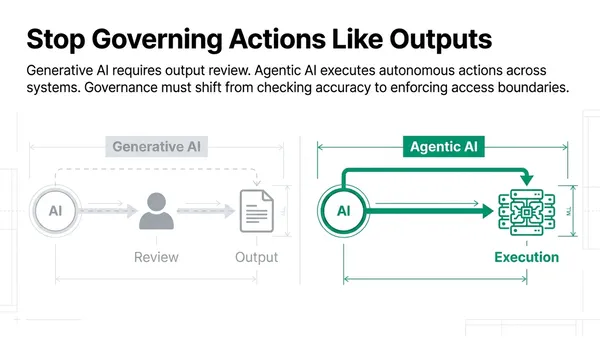
The central audit question has changed. It is no longer sufficient to ask whether a generative AI model produces acceptable answers. Enterprises must establish what data the system accessed, which sources influenced its output, what actions it was authorised to take, who could stop or override it and whether those controls operated in live conditions.
This matters because enterprise AI is moving from drafting and summarising towards systems that initiate actions. McKinsey’s 2026 survey found that 40% of respondents from organisations with more than US$1 billion in annual revenue reported scaling AI agents, compared with 27% in the previous survey. IBM separately reported that 48% of surveyed AI leaders said agents initiate and execute actions across workflows.
Those figures describe survey responses, not independently verified deployment levels across all enterprises. They do, however, show why a traditional model-centric review is increasingly inadequate. A writing assistant and a customer-service agent may use the same underlying model, but they do not create the same compliance exposure. The second may retrieve customer records, update a case, issue a refund or trigger a payment.
The supplied evidence supports describing the following as easy-to-miss gaps. It does not independently prove that most enterprises have failed each control. That distinction matters: a credible audit report should separate observed evidence, reported survey findings and professional judgement.
Eight compliance gaps an enterprise audit should test
The inventory records products, but not actual workflows
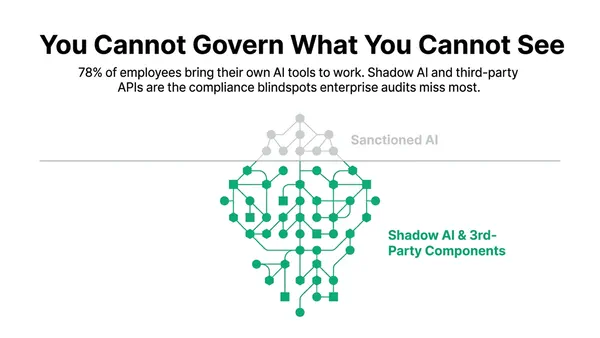
Many registers identify approved AI vendors without showing how the technology is being used. That can omit AI features embedded in existing business software, employee-adopted tools, pilots that have become operational and automated workflows assembled from several services.
An effective audit reconciles the AI register with procurement records, approved application lists, SaaS configurations and interviews with business teams. Each entry should identify its purpose, owner, users, data categories, model or service version, connected tools and whether the system recommends, decides or acts.
Shadow AI belongs in this assessment. A policy that covers only centrally purchased tools cannot demonstrate control over personal accounts, browser extensions or unapproved integrations processing company information.
The legal classification follows the product name
Calling something a “chatbot”, “copilot” or “writing assistant” does not determine its legal treatment. Classification depends on the purpose, affected people, jurisdiction, deployment context and the organisation’s role.
An AI writing tool used by a marketing team is not automatically a high-risk system because it is used by an employer. A recruitment screening workflow may require a substantially different assessment because it influences access to employment. The audit should document the reasoning, the applicable obligations, any claimed exemption and the trigger for reassessment.
This also prevents a common mistake: treating a voluntary framework or supplier certification as a substitute for checking applicable law. NIST’s Generative AI Profile and ISO/IEC 42001 can help structure governance and risk management, but neither removes the need for a jurisdiction-specific legal assessment.
Privacy review stops at the prompt
A privacy review that examines only what a user types into a prompt misses much of the data lifecycle. Information may also appear in uploaded files, retrieval indexes, system instructions, outputs, review queues, logs, monitoring tools and supplier systems.
The audit should trace data through each stage and compare the actual configuration with contractual and privacy commitments. That includes retention, deletion, access restrictions, vendor processing and the treatment of personal or confidential information. Where processing is likely to create a high risk to individuals, the organisation should assess whether a data protection impact assessment is required.
For a knowledge assistant, access control is particularly important. The system should not disclose information merely because it can retrieve it. A user’s entitlement to the underlying document must remain valid through the AI interface, and consequential answers should be traceable to sources that the user is allowed to inspect.
The agent has more authority than its job requires
Prompt instructions are not a reliable substitute for technical boundaries. An agent told not to issue refunds, alter records or disclose information may still attempt those actions if its connected tools and credentials permit them.
The audit should compare read and write permissions with the workflow’s actual business need. It should examine approval thresholds, sensitive actions, separation of duties, suspension mechanisms and the ability to switch safely to a manual process.
A useful test is to deliberately present an out-of-scope action and verify that the system blocks it at the architectural or application layer. The evidence should show not only that the agent refused in one test, but that its credentials, APIs and workflow controls prevented the action from being completed.
“Human in the loop” means a title rather than a control
A named reviewer does not automatically provide meaningful human oversight. A person who receives an opaque recommendation seconds before a deadline, lacks authority to change it or is measured only on speed may be unable to provide genuine review.
Production samples should show whether reviewers had the relevant information, enough time, appropriate training and authority to disagree. The organisation should also test whether affected individuals can obtain information about a decision, make representations, reach a human reviewer and contest the result where applicable.
This is especially relevant in the UK. The Data (Use and Access) Act 2025 amended, rather than replaced, the UK GDPR framework for automated decision-making. Wider use of significant solely automated decisions does not remove the need for safeguards. Special-category data also attracts additional restrictions.
IBM’s 2026 research illustrates the difference between policy and operation. Although 73% of surveyed leaders said they had defined where human oversight was non-negotiable, only 61% said AI decision rights were clearly defined and consistently applied. These are different survey questions, not a measured audit failure rate, but the distinction is useful: written oversight rules are not proof that oversight works.
Evaluation measures average accuracy but not expensive failures
A system may perform well on average while failing in ways that create legal, financial or safety consequences. Testing should therefore include realistic tasks, unusual cases, high-impact exceptions, inappropriate disclosures, unsupported claims and inconsistent outcomes across relevant groups where lawful and appropriate.
Evaluation should also measure safe abstention. A system that can state uncertainty, request clarification or escalate to a person may be safer than one that produces a confident answer for every request.
For each material workflow, the audit should be able to identify the versioned test set, pass criteria, failure categories, results and release decision. A general statement that the model was “tested for accuracy” is not enough to establish what risks were examined or which failures were considered acceptable.
Supplier approval is treated as permanent
Approval of a supplier at onboarding does not prove that the deployed service remains unchanged. Hosted providers may change models, retrieval behaviour, system limits, terms, logging arrangements or subcontractors. Internal teams may also alter prompts, data sources, permissions and user populations without reopening the original assessment.
The audit should identify which changes trigger reassessment and who is responsible for monitoring them. Evidence may include supplier change terms, version histories, regression tests, approval records and a tested fallback. The organisation should be able to explain what happens if a provider deprecates a model or introduces a change that affects performance or data handling.
A supplier’s certification may be relevant background evidence, but it does not establish that the enterprise’s particular configuration, integrations and purpose are compliant.
The enterprise cannot reconstruct an incident
If an AI-generated recommendation, decision or action is challenged, the organisation must be able to reconstruct what happened without retaining unnecessary personal data or confidential material indefinitely.
A practical test is to select a recent production event and trace its configuration, input context, retrieved sources, model or service version, tool calls, approvals, resulting action and response to any exception. The record should identify the incident owner, notification criteria and corrective action.
This is not an argument for logging everything. Excessive logging can increase privacy, security and confidentiality risks. The objective is proportionate evidence that connects the event, configuration, authorisation and outcome, with appropriate access and retention controls.
Regulatory checks enterprises can still get wrong
EU compliance has several dates, not one deadline
The EU AI Act timeline should be mapped by use case, role and obligation. The AI Omnibus entered into force on 27 July 2026, but that did not create a single compliance date for every AI system.
Prohibited-practice rules and AI literacy requirements began earlier, while obligations for general-purpose AI models began applying from 2 August 2025, subject to transitional arrangements. Article 50 transparency requirements began applying from 2 August 2026. These duties are not simply a requirement to label every AI output: they can involve informing people that they are interacting with AI, provider marking obligations and deployer disclosures where applicable.
The transition ending on 2 December 2026 applies to certain marking requirements for providers whose systems were placed on the market before 2 August 2026. It is not a general extension of all transparency obligations. Revised dates for certain high-risk systems include 2 December 2027 for relevant Annex III systems and 2 August 2028 for high-risk AI covered by Annex I product rules.
An audit should therefore contain a dated applicability assessment, identify the organisation’s role and link each obligation to an accountable owner. It should not rely on an outdated statement that all high-risk obligations began at the same time.
UK audits should test meaningful intervention
In the UK, the practical question is whether a reviewer can understand the basis of a decision and change its effect before it takes place. A sign-off box, an automated escalation email or the existence of a compliance committee does not answer that question.
The audit should examine actual decisions and the information provided to reviewers and affected people. It should test representations, human intervention and contest routes, rather than merely confirming that these terms appear in a policy.
Regulatory consultations and future codes should also be distinguished from obligations already in force. The ICO’s 2026 call for evidence on agentic AI was intended to inform a future statutory code; it was not itself a new legal requirement. That does not make the underlying privacy and accountability risks optional, but it does require careful wording in an audit report.
What evidence demonstrates that controls operate?
A defensible audit connects each workflow to its obligation, control, test, evidence, owner and remediation. The evidence should be specific enough for another reviewer to reproduce the conclusion.
For an agent, this might include a permission matrix, an approval record, a blocked out-of-scope transaction and proof that the workflow could be paused. For a decision-support system, it might include reviewer records, overrides, reasons for disagreement and evidence that affected people could obtain meaningful review. For a content-generation workflow, it should address licensing of source material, verification of quotations and claims, and any required disclosure or synthetic-content marking.
Testing should use a defined production sample rather than policy documents alone. The audit report should state the period covered, the workflows included, the number and type of cases examined and any evidence gaps. A control that exists on paper but was not enforced in sampled transactions should be recorded as a design or operating deficiency, not treated as fully effective.
Release decisions also need pre-agreed criteria. For example, an enterprise might allow a customer-service agent to draft a refund but require staff approval before payments above an internally selected threshold are executed. The amount is an illustrative business rule, not a regulatory threshold. The important audit question is whether the system technically enforced the approval and whether the service could continue safely in manual mode.
How to run a risk audit that remains useful after publication
Prioritisation should begin with potential harm rather than model size. Give early attention to workflows affecting people, handling sensitive information, reaching large audiences or taking difficult-to-reverse actions. Consider severity, likelihood, scale and reversibility, then assess residual risk after controls. Mandatory legal gaps should remain visible rather than disappearing inside an average risk score.
Ownership should be explicit. A practical accountability structure separates the model owner, who is responsible for performance and intended use; the incident owner, who can coordinate triage, rollback and communications; and the audit owner, who can assemble evidence for internal or external review. These roles may be assigned to different people or teams, but “the AI team” is rarely a sufficient answer.
The audit should also define what triggers reassessment. A new model version, wider permissions, a new retrieval source, a different user population or a move from recommendation to execution can all alter the risk profile. Each finding should have an owner, due date, interim safeguard and closure test.
Finally, reporting should help leadership make a decision. A board-level report should show the highest residual risks, overdue remediation, untested intervention mechanisms and workflows where evidence is incomplete. The decision may be to restrict scope, fund a control, pause deployment or accept a documented risk where that is lawful and defensible.
A dashboard can support this process, provided its denominators are clear. The proportion of in-scope workflows with verified owners, the percentage of material changes retested before release, the rate of actions with approval evidence and the age of high-severity findings are more useful than a headline showing that nearly all registered systems have owners. That headline is misleading if the register excludes embedded tools and shadow AI.
The strongest 2026 audit is therefore not a one-off review of a model card or policy. It is a test of whether the enterprise can control, observe and explain a live workflow from data access through to decision or action.
Research Insights
| Topic / Area | Key Finding | Business Impact | Why It Matters |
|---|---|---|---|
| AI agent adoption | 40% of large-organisation respondents scaled agents | More workflows can take action | Permissions and approvals need testing |
| Agent governance | 48% reported agents executing workflow actions | Model errors can become transactions | Output review alone is insufficient |
| EU transparency | Article 50 rules applied from 2 August 2026 | Disclosures need use-case mapping | “Label everything” is too simplistic |
| UK automated decisions | Safeguards remain for significant decisions | Review routes must work in practice | Nominal human oversight may be inadequate |
| Audit frameworks | NIST and ISO/IEC 42001 structure controls | Better evidence and accountability | Voluntary frameworks do not replace law |
Sources
- McKinsey & Company – The State of AI
- IBM – AI leaders, agents and governance
- European Commission AI Act Service Desk – Implementation timeline
- Information Commissioner’s Office – Data Use and Access Act 2025
- NIST – Artificial Intelligence Risk Management Framework: Generative AI Profile
Frequently Asked Questions
Is a generative AI audit different from a traditional IT audit?
Yes. A traditional IT audit may focus on access, change management and system availability. A generative AI audit must also examine probabilistic outputs, data lineage, evaluation quality, human intervention, model changes and whether an agent can take actions beyond its intended purpose.
What should be included in an enterprise AI inventory?
The inventory should record each use case rather than only each supplier. Include its purpose, owner, users, data types, model or service version, connected tools, jurisdiction, affected people and whether it provides information, recommends a decision or executes an action.
Does buying an AI service transfer compliance responsibility to the supplier?
No. Supplier due diligence is important, but the deploying organisation remains responsible for how the service is configured and used. A vendor assurance report cannot prove that the enterprise’s own data flows, permissions, purposes and human review controls operate correctly.
How often should an AI risk audit be repeated?
There is no universally suitable annual interval. Reassessment should occur after material changes, including a new model, wider permissions, different data sources, a new user population or a change from recommendation to execution. Production monitoring should identify when an earlier review is needed.
What is the difference between human oversight and human approval?
Human oversight requires a person to understand the relevant information, intervene effectively and have authority to change or stop the outcome. Human approval can be purely formal if the reviewer lacks time, context or practical control, so audit testing should examine real decisions rather than job titles.