
Summary
An AI audit is a structured review of how a business chooses, uses, governs and monitors artificial intelligence. It examines systems, data, suppliers, performance, security, fairness, transparency and human oversight. For UK businesses, an audit helps identify shadow AI and operational risks, support UK GDPR compliance, prevent harmful decisions, protect confidential information and confirm that AI is delivering genuine business value.
Key Takeaways
- An AI audit reviews business processes and decisions as well as the technology itself.
- UK businesses remain responsible for how AI processes data and influences outcomes.
- Shadow AI, supplier weaknesses and ineffective human oversight are common risk areas.
- A useful audit produces an inventory, risk assessment, remediation plan and monitoring process.
- AI audits can identify worthwhile efficiency opportunities, not just compliance problems.
An AI audit examines how your business uses artificial intelligence
An AI audit is a structured assessment of the artificial intelligence used by an organisation. It considers how systems are selected, deployed, operated, governed and monitored, rather than looking only at the underlying model or software.
The review may cover an AI chatbot, recruitment screener, customer-service tool, fraud detection system, predictive model, generative-AI assistant or AI feature built into ordinary business software. It should also examine the decisions surrounding each system: who approved it, what purpose it serves, which data it uses, who is accountable and what happens when its output is wrong.
This makes an AI audit different from a conventional IT audit. An IT audit may assess access controls, infrastructure and cybersecurity. A financial audit examines financial records and controls. An AI audit may review those areas, but also tests whether an AI system is accurate, explainable, fair, appropriately supervised and suitable for the business process in which it is being used.
The practical outcome is normally an AI inventory, risk register, control-gap assessment and prioritised remediation plan. It should also establish how the system will be monitored after the review. An audit that produces a report but no owners, deadlines or follow-up checks is unlikely to provide much lasting value.
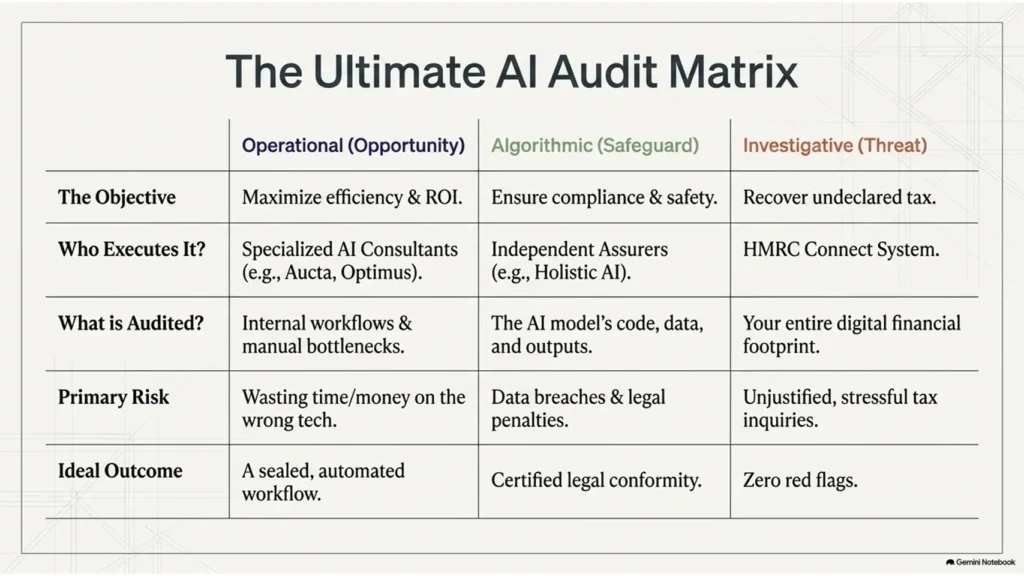
There are two main business purposes for an AI audit
The phrase “AI audit” is used to describe more than one type of review. Clarifying the purpose at the outset prevents a business from commissioning the wrong exercise.
An opportunity audit identifies where AI could create value
An AI opportunity or readiness audit looks at how a business operates and identifies processes where artificial intelligence might improve speed, quality, service or cost efficiency. It may uncover slow quotation processes, repetitive administration, delays in responding to enquiries or manual data-entry work.
This type of review is generally carried out before a new system is selected. It starts with the business problem rather than a software demonstration. The conclusion may be that AI is appropriate, that a simpler form of automation would be better, or that the process needs to be improved before any technology is introduced.
For a smaller business, this can be a practical way to avoid buying software that does not solve a genuine problem. Recommendations should be sequenced according to business value, implementation difficulty and risk, rather than attempting to automate every process at once.
A governance audit assesses an AI system already in use
An AI governance, risk or compliance audit examines an active system. It asks whether the business is using it lawfully, safely and consistently with its intended purpose.
The review may assess personal-data processing, fairness, accuracy, security, supplier terms, transparency, access controls, human review, complaint handling and the system’s ability to cope with unusual or changing circumstances.
The two approaches can overlap. A business considering a new recruitment platform, for example, may first assess whether automated screening is worthwhile and then examine whether the proposed system creates unacceptable risks for applicants.
Why AI audits are important for UK businesses
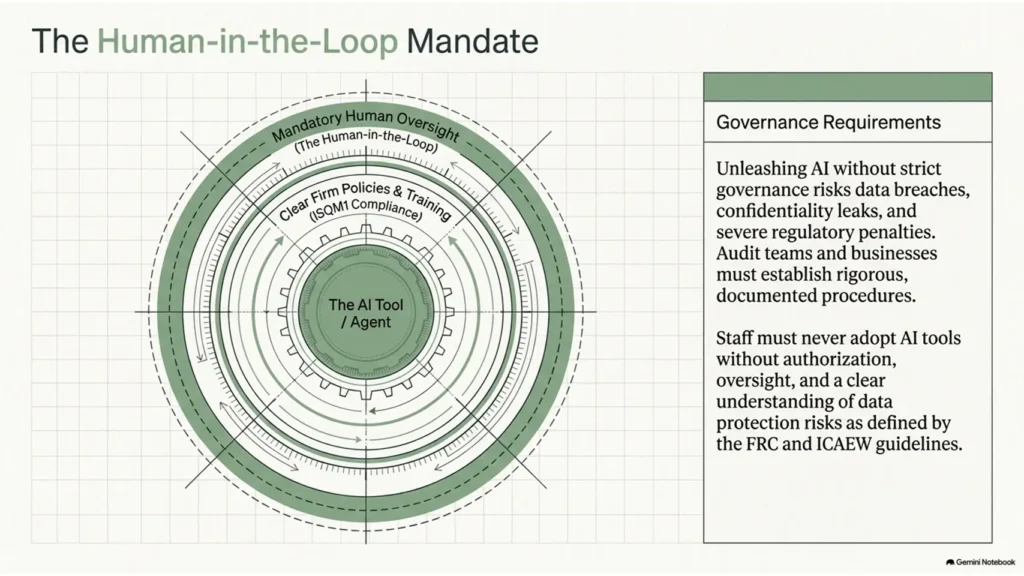
AI adoption is no longer limited to large technology companies. Businesses may use artificial intelligence through customer relationship management systems, office software, recruitment platforms, marketing tools, accounting products and public generative-AI services. Some tools may have AI features enabled by default, while employees may use unapproved tools without informing management.
The research indicates that AI use among UK businesses is growing, although many adopting organisations use only a small number of AI technologies. That combination creates a practical governance challenge: businesses may have several AI-related risks without having a central view of where the systems are or what they do.
Businesses remain responsible for outcomes
Buying an AI product from a reputable supplier does not transfer responsibility for how the business deploys it. An organisation still needs to understand what data enters the system, how outputs influence decisions and whether staff are capable of identifying errors.
This is especially important where AI affects customers, employees, candidates, borrowers, claimants or other individuals. A model may appear reliable in general testing but perform poorly for a particular group, language, customer segment or unusual situation.
An audit can identify these weaknesses before they lead to an inappropriate decision, complaint, discrimination allegation, data incident or reputational damage. It can also determine whether staff are relying on AI output without applying sufficient professional judgement.
UK law already applies to many AI uses
The UK does not have one all-purpose AI Act governing every business and every use of artificial intelligence. That does not mean AI operates outside regulation. Existing laws and sector requirements can apply depending on the data, purpose and impact of a system.
The UK GDPR and Data Protection Act 2018 are central where personal data is involved. An audit may therefore need to examine lawful basis, fairness, transparency, accuracy, data minimisation, purpose limitation, security, retention and accountability.
A data protection impact assessment, or DPIA, is particularly important for higher-risk processing. The ICO identifies systematic and extensive profiling and automated evaluation that produces legal or similarly significant effects as circumstances in which a DPIA is always required. Examples may include automated decisions that deny a product, service or benefit.
Where a decision is solely automated and has legal or similarly significant effects, affected individuals may have rights relating to human intervention, expressing their view, contesting the decision and receiving an explanation. An audit should test whether these safeguards work in practice, rather than simply checking whether a policy mentions them.
The Equality Act 2010 may also be relevant. Recruitment, promotion, credit, insurance and access-to-service decisions should be assessed for potential direct or indirect discrimination. Financial services, healthcare, education, legal services and critical infrastructure may involve additional regulatory or contractual expectations.
The ICO’s AI guidance is under review following the Data (Use and Access) Act 2025. Businesses should therefore check current regulatory guidance when completing an audit instead of relying on older summaries of the law.
It protects confidential and personal information
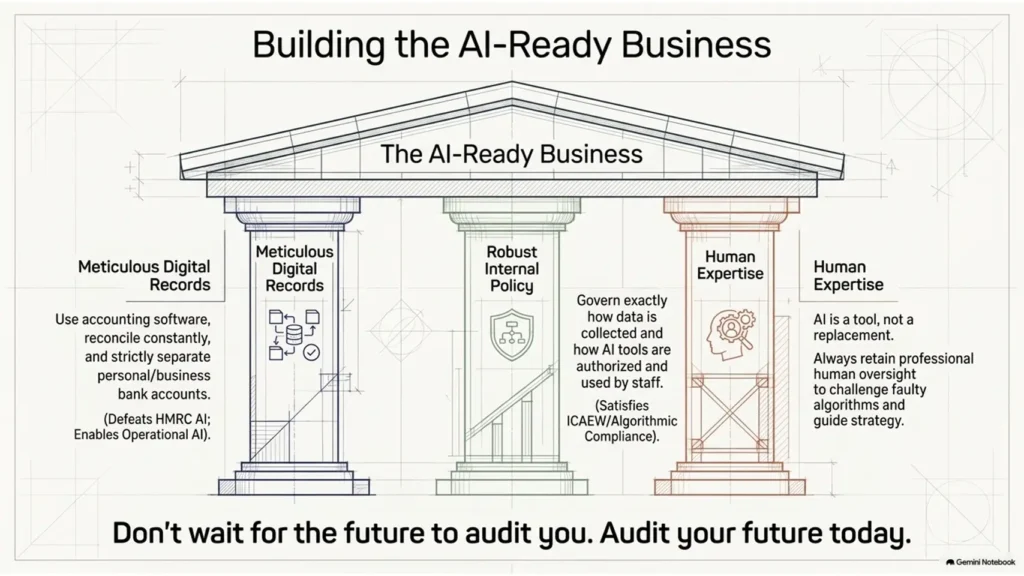
Employees may paste client details, commercially sensitive material, customer records or internal documents into public AI tools. This is often called shadow AI: the use of artificial intelligence without formal approval or adequate management oversight.
The risk is not limited to a malicious data breach. A business may not know how a provider stores prompts, whether people review submissions, whether data is used for model improvement, which subprocessors are involved or where information is transferred.
An audit should identify both approved and unapproved use. It should review supplier contracts, retention terms, training-data practices where available, access permissions and the controls preventing sensitive information from being uploaded unnecessarily.
It tests whether AI delivers real business value
An audit should not assume that using AI is beneficial simply because a tool is modern or technically impressive. It should establish what improvement the system is expected to produce and how that improvement will be measured.
Depending on the use case, relevant measures might include factual error rates, response times, escalation rates, processing costs, resolution times or the quality of human decisions. If the system does not deliver a meaningful improvement at an acceptable level of risk, the business may need to redesign, restrict or discontinue it.
What a robust AI audit covers
Establishing ownership and creating an inventory
The audit begins by defining its scope. This may include business units, systems, suppliers, geographical markets and decisions. Responsibility should be assigned to appropriate business, technical and data-protection owners.
The organisation then creates an inventory of AI systems. Each entry should record the provider, purpose, users, data types, integrations, model or feature type, decision impact and system owner. Embedded AI in software-as-a-service products should be included, not just bespoke models developed internally.
Mapping data and decision flows
The auditor should establish what enters the system, where it is stored, who can access it and where outputs go. Supplier terms should be checked to determine whether customer data or prompts may be retained, reviewed or used for training.
The review should also consider international transfers, retention periods, deletion processes and how an AI output becomes a business decision. A system that merely drafts an internal summary presents a different level of risk from one that recommends rejecting a customer or ranking job applicants.
Testing performance, fairness and security
Testing should reflect the real business process, not just a vendor demonstration. The audit should examine accuracy, reliability, error patterns, hallucinations, unusual cases and performance across relevant groups.
Security testing may include the risk of confidential-data leakage, prompt injection, adversarial inputs, unsafe autonomous actions and inappropriate access to connected systems. Logs should contain enough information to investigate important outcomes without retaining unnecessary personal data.
The business should define unacceptable failure modes and establish what happens when they occur. Operationally significant systems may require rollback procedures, a manual fallback or a means of stopping the system quickly.
Checking whether human oversight is meaningful
A human reviewer is not automatically an effective safeguard. If the person lacks time, training, authority or relevant information, they may simply approve whatever the system recommends.
Meaningful oversight requires the reviewer to understand the system’s limitations, assess the recommendation independently and have the authority to reject it. The process should also provide a practical route for an affected person to ask questions, challenge an outcome or request human review.
Assessing suppliers and documenting remediation
Supplier assurance is useful, but a vendor questionnaire is not a complete AI audit. The business must assess whether the product is appropriate for its own data, customers, processes and risk profile.
The review should seek evidence about security, privacy, model changes, testing, incident notification, service levels, subcontractors, audit rights and exit arrangements. Findings should then be ranked according to potential harm, legal exposure, affected people and business criticality.
Every remediation action should have an owner, deadline, evidence requirement and planned re-test date. High-risk systems need more frequent monitoring, particularly after a material change to the model, data, supplier, workflow or regulatory environment.
Common AI audit mistakes
One common mistake is auditing only systems built by the internal technology team. AI-enabled features in recruitment, customer relationship management, meeting tools, search platforms and workflow software can create significant risks even when the business did not develop the model.
Another is treating overall accuracy as proof of fairness. A system can perform well on average while producing materially worse outcomes for a particular group. Testing must therefore reflect the people and circumstances affected by the process.
Businesses also sometimes confuse a supplier’s free consultation with an independent audit. A sales consultation is designed to demonstrate a particular product. An independent audit should be able to conclude that the product is unsuitable, that additional controls are required or that AI is not the right solution.
Finally, an audit should not be treated as a one-off approval. AI systems and suppliers change, business data shifts and new integrations can alter the risk. Monitoring and reassessment should be built into normal governance.
Relevant standards and assurance frameworks
ISO/IEC 42001 is a voluntary international standard for an AI management system. It provides a structured framework covering governance, risk assessment, documentation, lifecycle controls, monitoring, internal audit and continual improvement. It can help an organisation organise its management system, but certification is not a universal legal safe harbour.
The UK government’s Trusted Third-Party AI Assurance Roadmap describes assurance as important to responsible and lawful AI development and deployment. The roadmap also points to a growing UK AI-assurance market. This reflects increasing demand from customers, boards, insurers and procurement teams for evidence that AI systems are being managed responsibly.
A UK business operating in or supplying the European Union may also need to consider the EU AI Act. Its relevance depends on the organisation’s role, market reach and use case; it does not automatically apply to every UK business.
For most organisations, the sensible starting point is not certification. It is a clear inventory, proportionate risk assessment, practical controls and evidence that those controls are operating.
When should a UK business arrange an AI audit?
An audit is appropriate before deploying a system that will process personal or confidential data, make recommendations about people or connect to important internal systems. It is also advisable when a business discovers unapproved AI use, changes supplier, materially changes a model or receives concerns about accuracy, fairness or transparency.
Smaller businesses do not necessarily need an enterprise-scale technical assessment. A proportionate review of AI-enabled software, staff usage, data handling, supplier terms and high-impact processes may expose the most important risks. The essential point is to match the depth of the audit to the potential consequences of failure.
For a business that has not yet adopted AI, an opportunity audit can identify worthwhile uses and prevent poorly targeted investment. For a business already using AI, a governance audit can establish whether current practices are safe, lawful, explainable and commercially justified.
Research Insights
| Topic / Area | Key Finding | Business Impact | Why It Matters |
|---|---|---|---|
| UK AI adoption | About 35% reported use by mid-2026 | More businesses require practical controls | AI governance is becoming mainstream |
| High-risk processing | ICO says some profiling requires a DPIA | Higher preparation and documentation burden | Rights and freedoms may be affected |
| Automated decisions | Safeguards include human intervention and challenge | Poor processes can harm individuals | Oversight must work in practice |
| AI assurance market | Over 524 UK companies; £1.01bn estimated GVA | More assurance support is available | Demand for evidence is increasing |
Sources
Office for National Statistics – Business Insights and Impact on the UK Economy
Information Commissioner’s Office – Legal framework for explaining AI decisions
Information Commissioner’s Office – Individual rights in AI systems
UK Government – Trusted Third-Party AI Assurance Roadmap
Frequently Asked Questions
Is an AI audit required for every UK business?
No. There is no general requirement for every UK business to complete the same type of AI audit. The need for assessment depends on the system, data, decisions, affected people, sector and market. Higher-risk processing may trigger specific legal duties, including the need for a DPIA.
Does an AI audit include tools such as ChatGPT?
It should if employees use them for work. The audit should establish what information staff enter, which accounts they use, whether confidential data is permitted, how outputs are checked and whether usage is recorded. Unapproved use by employees is commonly known as shadow AI.
Who should be responsible for an AI audit?
Responsibility should be shared rather than left solely to IT. A suitable review normally involves an accountable senior owner, technical and information-security specialists, a data-protection lead and the owner of the business process affected by AI.
How often should an AI audit be repeated?
The review should be revisited after significant changes to a model, supplier, dataset, workflow or regulation. Monitoring frequency should reflect risk. A system influencing employment, finances, rights or safety needs closer ongoing attention than a low-risk productivity assistant.
Does ISO/IEC 42001 prove that an AI system is compliant?
No. ISO/IEC 42001 provides a voluntary management-system framework for organising AI governance and continual improvement. It can support assurance and certification, but it does not remove the need to meet UK data-protection, equality, sector-specific or contractual obligations.
If you want to find out how we can help your business with AI Audits then please contact us.